Deployments
No borrowed proof. Here is what can actually be shown.
Versidon has no public customer references yet, so this page does not pretend otherwise — there are no logos, no named institutions and no testimonials on it. What follows is the work the platform is deployed against, what a deployment looks like week to week, and what a serious pilot involves.
The work it is deployed against
Five shapes of work, each with a document trail behind it.
These are recurring, evidence-bound tasks that a finance team already does on a cycle. They are where Versidon is put to work, because they are where the sources, the review standard and the sign-off are already defined.
Annual credit reviews
A borrower file becomes a review pack: statements spread, ratios recalculated, covenants tested against the executed agreement, prior-year commentary carried forward with its source attached. The exceptions appear in the first paragraph rather than in an appendix.
Credit workspaceAML case investigation
An alert is triaged against the transaction history, the KYC record and the sanctions and adverse-media hits together. What comes out is a case narrative in the MLRO's structure — observed, checked, unexplained — with each statement pointing at the record behind it.
Compliance workspaceEarnings research
A quarter is read against the prior quarter and against what management said then, with the changed language quoted. The brief cites each takeaway to a page in the filing or the transcript, so an analyst can check it before it becomes a house view.
Research workspaceDiligence tracking
Workstreams and request logs are kept current across the data room: what was asked, what arrived, what is outstanding and who owns it. Contract terms that matter are surfaced with their clause references rather than summarised away.
Deals workspacePayment exception handling
An exception queue is worked with the underlying instruction and prior handling attached, service levels visible on the item itself, and a release pack prepared to the point of decision — the correction proposed, the impact stated, the residual risk named.
Operations workspaceWhat a deployment looks like
One team, one workflow, then wider.
The sequence below is how we run it. The order matters more than the calendar: access and format are settled before anyone argues about output, and governance reviews the log rather than a summary of it.
- STAGE 01Connect
One workspace, real documents
A single team, a single workspace, and the documents that team actually works from. Sources are indexed inside your tenant and entitlements are inherited from the systems that already hold them, so access is verified before anyone is asked to judge output quality.
- STAGE 02Calibrate
Your format, your policy
The work product is shaped to your house template, not ours: the order of a memo, the structure of a case narrative, the phrases your reviewers expect. Policy sets and thresholds are attached, and labelled cases are drawn from work your team has already signed.
- STAGE 03Run in parallel
Compared against the way you do it today
The team keeps its current process and runs the same files through Versidon alongside it. Reviewers mark what they accepted, amended and rejected. That review record is the evidence base for whether it is working — and it belongs to you.
- STAGE 04Review
Governance reads the log, not a slide
Security, audit and model-risk reviewers work from the registries and the event log directly: which models were approved, which agents ran, under what entitlements, on which entities, and what a person did with each draft.
- STAGE 05Widen
Second team, same controls
Scope grows one team or one workflow at a time, inheriting the same entitlement model, the same audit log and the same evaluation gates. Agents that fall below threshold do not publish; versions roll back in one step.
Illustrative scenario
A quarterly review cycle, described as an example.
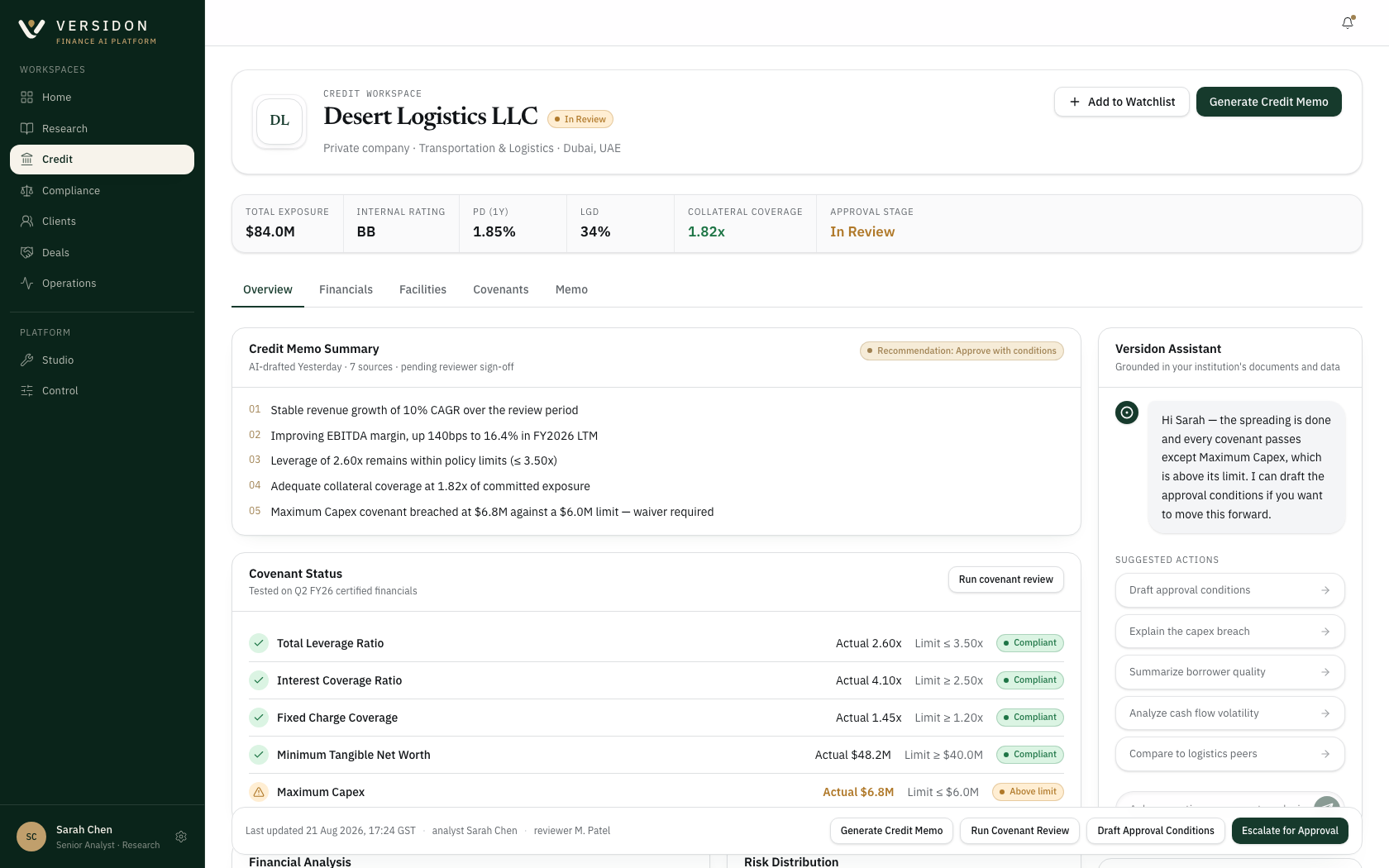
The following is an illustrative scenario, not a customer. It describes a typical shape of work rather than a deployment that has happened, and no part of it should be read as a reference.
ILLUSTRATIVE SCENARIO — NOT A CUSTOMER
A mid-market lending team has a quarterly monitoring cycle over a portfolio of borrowers. Management accounts arrive on staggered dates and each one has to be spread, tested against the covenants in the agreement in force, and written up for the watchlist. In this scenario Versidon prepares each file as it lands: it spreads the accounts, names the adjustments and their stated basis, tests the covenant definitions from the executed document rather than from a template, and drafts the monitoring note with each figure linked to the page it came from.
The analyst reviews and amends; agent-written blocks are marked and reversible until accepted. Where an addback has no support in the documents, the draft says so instead of adopting it. Rating changes and watchlist decisions stay with the credit officer who holds that entitlement, and every step — human and agent — is on one audit log.
What a pilot involves
Four conditions we ask for, and one we insist on.
A defined scope
One workflow, one team, one document set. A pilot that spans four departments proves nothing in particular.
Success criteria set in advance
Written down before the work starts, in your terms — reviewer acceptance, evidence quality, exceptions correctly raised — and measured on your files rather than on a demo corpus.
Your reviewers in the room early
Security, compliance and model risk join at the start, not at the end. The controls are the product, and they are easier to assess against real work than against a questionnaire.
An exit that is yours
Your documents, your work product, your evidence trail and your audit log stay in your tenant and are exportable. A pilot you cannot walk away from is not a pilot.
The one we insist on: the pilot runs on your documents. A platform that only performs on a curated corpus has not been tested.
Straight answers
What we will not claim, and why.
- Why are there no customer logos on this page?
- Because we do not yet have references we are permitted to name. Publishing a logo or a quotation we cannot stand behind would be the first thing a diligence process caught, and rightly so.
- Are there numbers behind these claims?
- Not ones we are prepared to publish. Time-saved figures depend on the desk, the document set and the review standard, and a number without that context is decoration. In a pilot the numbers are measured on your files, and they are yours.
- So what can be verified before we commit?
- The mechanics. How a citation resolves to a passage, how an entitlement is enforced at query time, where the platform stops for a human decision, what the audit log records, and how an agent is evaluated before it is allowed to publish. All of it can be examined in a session.