Underwriting and monitoring
Spread the financials, test the covenants, draft the memo.
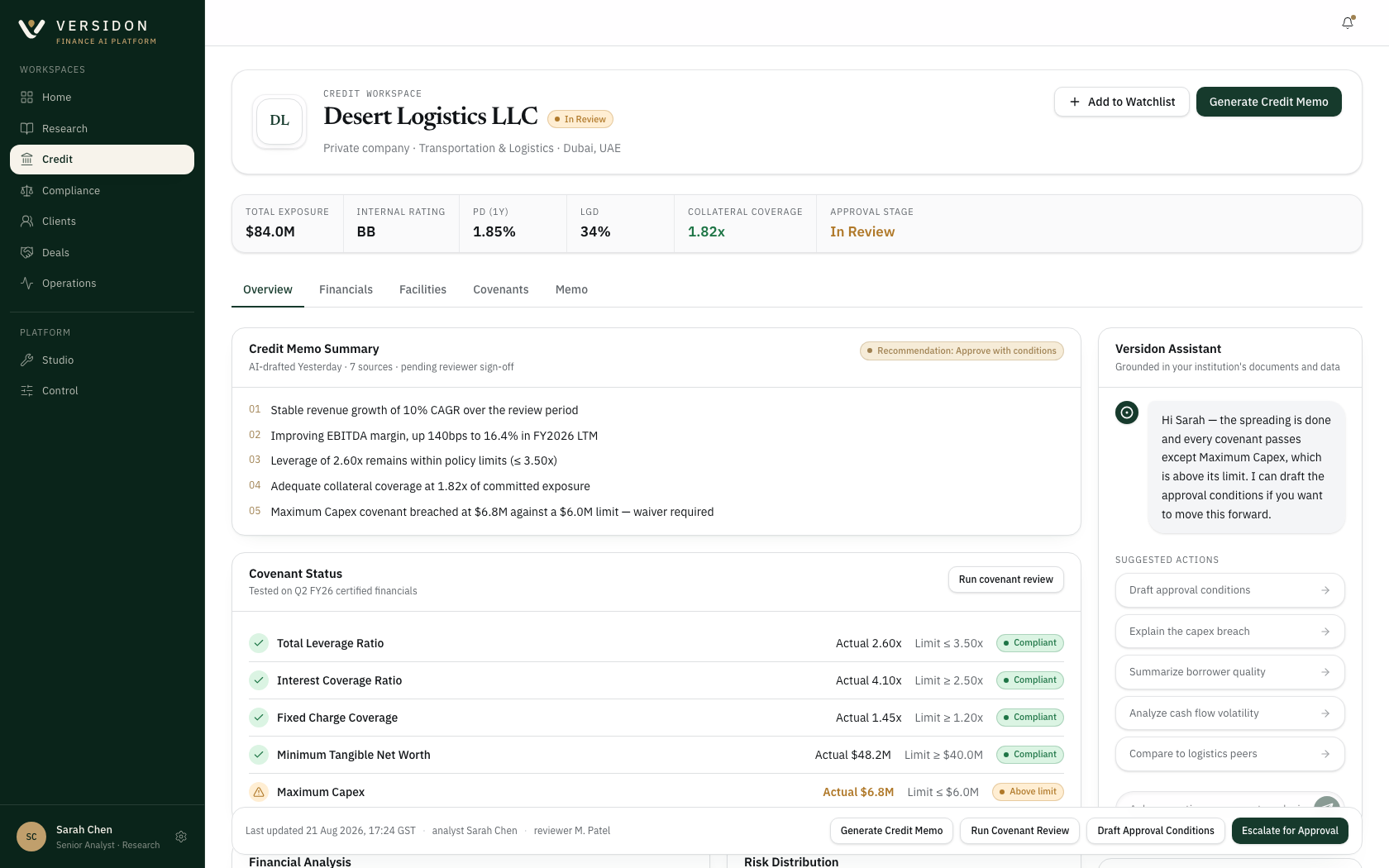
Credit spreads certified financials across periods, tests the full covenant package, flags breaches with the headroom remaining, and drafts the memo. Facilities reconcile to committed exposure. The exceptions are named in the first paragraph, not buried in an appendix.
How it works
The spread, the tests and the memo are one chain of work.
Credit starts from the certified financials on file, not from a retyped summary. It builds the spread, runs each covenant against its own definition in the agreement, and carries the result straight into the memo — so the number in the memo and the number in the spread are the same number.
- 01
Spread certified financials
Statements are spread across periods on a consistent basis, with adjustments shown rather than absorbed. Each line traces back to the certified document it came from.
- 02
Test the covenant package
Every covenant in the package is tested against its definition in the agreement — not a generic ratio. Breaches are flagged with the headroom remaining and the period in which it narrowed.
- 03
Draft the memo
The memo is drafted into your template with the exceptions stated up front. Facilities reconcile to committed exposure, so the limit table and the exposure table agree.
What it produces
A memo that leads with what is wrong.
A credit memo is read by a committee under time pressure. Versidon writes it in the order a committee needs it: the exceptions first, the reconciliations attached, the escalation path already stated.
Period-over-period spreads
Certified financials spread on a consistent basis, with adjustments itemised and each line traceable to its source document.
Full covenant testing
The whole package tested against the definitions in the agreement, with results dated and the calculation shown.
Breaches with headroom
Breaches flagged with the headroom remaining and the trend that produced them, so a near-miss reads as a near-miss.
Facilities reconciled to exposure
The facility schedule reconciles to committed exposure. Where it does not, the memo shows the difference rather than netting it away.
Exceptions named first
The memo opens with its exceptions. A reviewer does not have to read to the appendix to find what the analyst was uncomfortable with.
Escalation to Credit Committee
Escalation routes to the Credit Committee, and the memo states plainly that the analyst holds initiator rights, not approval rights.
Where it stops
The analyst initiates. The committee approves.
Versidon does not approve a facility, waive a covenant or change a limit. It prepares the pack, states the residual risk and routes the escalation. Initiator, reviewer and authoriser stay distinct, and the agent never inherits a person's approval rights.
The analyst holds initiator rights, not approval rights. The platform is built so that distinction cannot be quietly lost.
Works with the rest of the platform
One record, one permission model, one audit trail.
Research
Company briefs built from filings, transcripts and your own notes, with every takeaway cited to a page.
Exceptions and service levelsOperations
Exception queues with live SLAs, and release packs that stop at the authoriser rather than past them.
Governance and auditControl
Model registry, agent registry, entitlements and an immutable event log covering every human and agent action.