Solutions
The same platform, doing your desk's actual work.
Versidon is not a general assistant pointed at a finance team. It works inside the credit, research, compliance, deal and operations files you already keep — drafting into them, citing what it used, and stopping short of any decision that is yours to make.
01 — Segment
Commercial & corporate banks
Annual reviews, covenant monitoring and payment exceptions, with maker-checker preserved end to end.
HEAD OF CREDIT, CHIEF RISK OFFICER, HEAD OF LENDING OPERATIONS
- 01
Annual review packs assembled from the borrower file: statements spread, ratios recalculated, prior-year commentary carried forward with its source attached.
- 02
Covenant tests run against the executed agreement, so a headroom figure points at the clause and the reporting period it was tested on.
- 03
Early-warning review of the portfolio — rating triggers, overdue reporting, drawn-line behaviour — written up as a watchlist note rather than a dashboard tile.
- 04
Payment and limit exceptions prepared for the authoriser with the residual risk named, never released by the agent.
Maker, checker and authoriser stay three different people across the whole chain, including where the first draft was written by an agent.
02 — Segment
Private credit & direct lending
Faster spreading and memo drafting without giving up the evidence trail your LPs expect.
INVESTMENT COMMITTEE, PORTFOLIO MANAGER, LP REPORTING LEAD
- 01
Spreading of borrower management accounts on a monthly or quarterly cycle, including the adjustments a sponsor made and the basis given for each one.
- 02
A drafted IC memo that opens with its exceptions: the addbacks that moved EBITDA, the covenant definitions that differ from the last deal, the assumptions no document supports.
- 03
Quarterly portfolio monitoring against the credit agreement in force — amendments, waivers and equity cures reflected rather than assumed away.
- 04
An evidence trail that survives an LP or valuation query, because every figure in the memo opens the page it was taken from.
The agent will tell you an addback is unsupported. It will not decide whether to accept it — that stays with the committee.
03 — Segment
Asset & wealth management
Research briefs and client meeting packs grounded in filings rather than in a model's memory.
HEAD OF RESEARCH, PORTFOLIO MANAGER, PRIVATE CLIENT COVERAGE
- 01
Company briefs built from filings, transcripts and the house's own notes, with each takeaway cited to a page rather than recalled from a model's memory.
- 02
Earnings turnarounds: the quarter read against consensus and against what management said last quarter, with the changed language quoted.
- 03
Thematic and sector screens that keep the underlying figures attached, so a claim in a client letter can be checked before it is sent.
- 04
Client meeting packs drawn from the relationship record — holdings, open requests, prior commitments — assembled before the meeting and filed after it.
Research written by an agent is marked as such and stays reversible until an analyst accepts it into the house view.
04 — Segment
Investment banking & advisory
Diligence trackers, comps and deal materials that reconcile to each other.
DEAL TEAM, DILIGENCE LEAD, FAIRNESS AND VALUATION REVIEWERS
- 01
Workstream and request-log tracking across the data room: what was asked, what arrived, what is still outstanding and who owns it.
- 02
Diligence read-throughs that surface the contract terms that matter — change of control, assignment, exclusivity — quoted with the clause reference.
- 03
Comparable company and transaction sets whose inputs reconcile to the filings and to the model sitting beside them.
- 04
Draft materials that carry their sources, so a page in a committee book can be defended line by line.
Nothing leaves the deal file on the agent's initiative. Distribution stays a person's action, under the entitlements the deal already carries.
05 — Segment
Compliance & financial crime
Alert triage and case narratives drafted for review, with the filing decision left to the MLRO.
CHIEF COMPLIANCE OFFICER, MLRO, HEAD OF FINANCIAL CRIME
- 01
Alert triage that reads the transaction history, the KYC record and the sanctions and adverse-media hits together, and says which of them actually bear on the alert.
- 02
A case narrative drafted in the MLRO's own structure: what was observed, what was checked, what remains unexplained — each statement pointing at the record behind it.
- 03
Periodic review and remediation queues worked file by file, with gaps in documentation named rather than silently inferred.
- 04
A complete history of the case, human and agent alike, exportable when an examiner asks how a conclusion was reached.
Versidon prepares the case. Whether to file is the MLRO's decision, and the platform stops there by design.
What it looks like
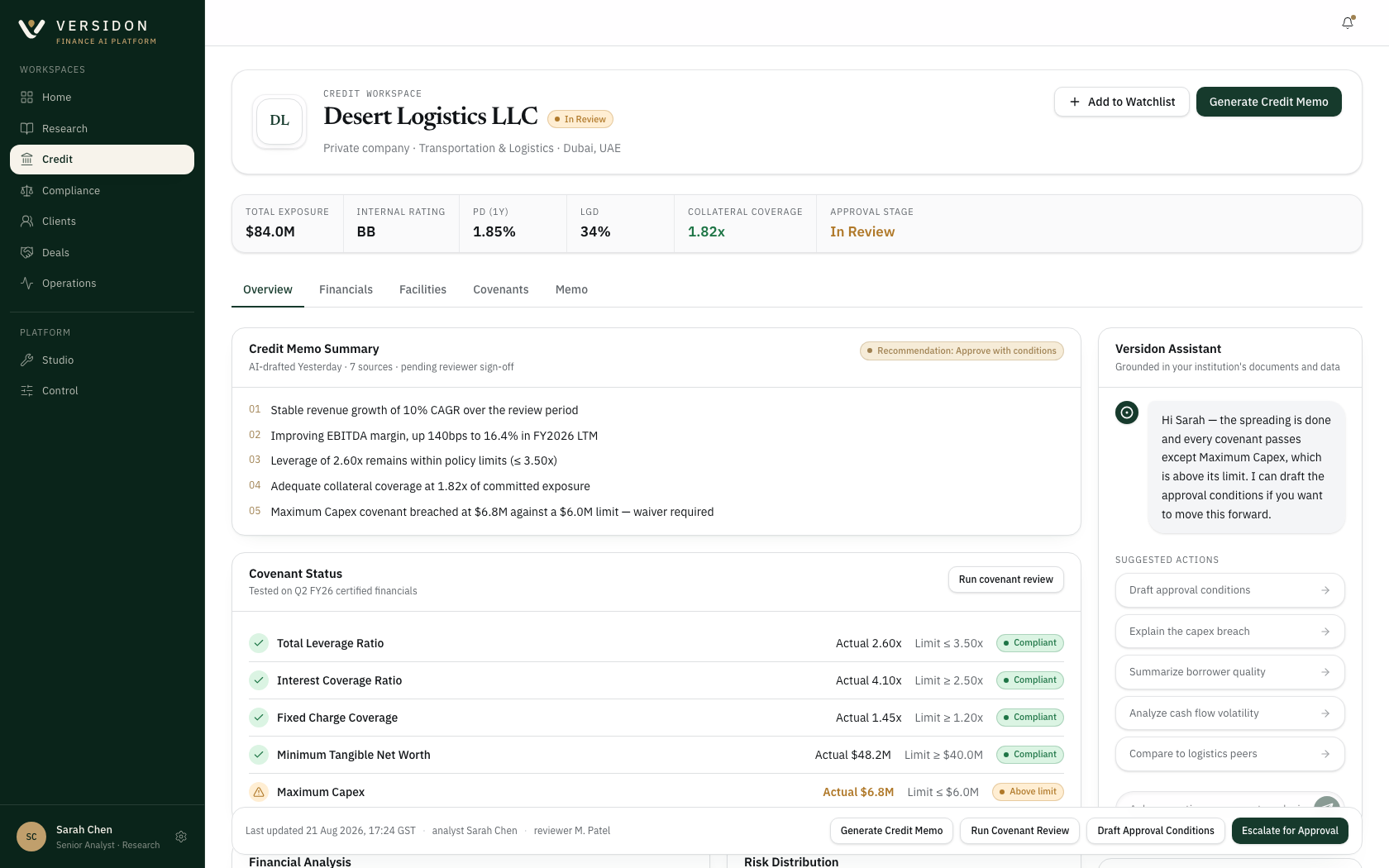
Whichever desk you sit on, the evidence comes attached.
A memo, a brief, a case narrative and an exception pack are different documents with the same discipline underneath: agent-written blocks are marked and reversible, every figure opens the passage it came from, and the decision waits for the person who holds the entitlement.